Tuesday, June 30, 2009

Arugula-Mint Salad with Apricots and Cumin


For some people, where we are is never quite where we'd like to be. Or rather, it's only one of many places we'd like to be. I live in Manhattan, and as much as I know that it's probably temporary (and I dread the day New York play time, as I like to call it, comes to an end), I regularly fantasize about all of those other places. Across oceans, on the one hand, and across a great mass of land on the other.

As a result of all of those places across the ocean, I do things like window shop in Alphabet City, an activity that too often turns into real shopping when I stumble on a little places, almost no more than literal holes carved into the sides of buildings. Like the Marrakech East on East 11th and one of those abecedarian cross-streets. Specializing in imports from Morocco, stacked and mismatched in the dimly lit room. Where the proprietor, with one working arm and one almost totally atrophied from disuse, directs you from his chair in the back of the shop to find the tissue paper, the wrinkled brown paper bags and the pen to sign your receipt, which might be under the two-ton cat with a human's name. It's the kind of place which claims not to accept credit cards, although the machine sits in plain sight, until you convincingly argue that you have only a twenty.


And as for that place across this great mass of land, I do things like recreate recipes from California kitchens. I fantasize about plucking my own apricots, one day, from a tree which would grow outside the bedroom window. Maybe I wouldn't even have to get out of bed, just reach out through fluttering curtains. I'd combine it with the mint and arugula sprouting from a tiny herb garden. Or I'd go straight to the source, Suzanne Goin's famed Lucques in Los Angeles, about which I have only read.


And on another tangent, I'm crazy lately about dressings thickened with fruit. I've shown you a curried date dressing already, and there's a fabulous watermelon salad that I made last summer, before the start of this blog, which definitely deserves a repeat performance. For this, just overripe apricots give body to the dressing and the same sliced fruit gives color to the salad. Marinating the shallot for 10 minutes in the acid helps to mellow its flavor, and although you'll have extra dressing, you can keep it for sprinkling on any stray bits of green throughout the week.

Arugula-Mint Salad with Apricots and Cumin
From Suzanne Goin of Lucques, via Melissa Clark's Chef Interrupted

For the dressing
6 tablespoons sherry vinegar
2 tablespoons red wine vinegar
1 large shallot, diced
1/2 teaspoon ground cumin
1/2 teaspoon salt
2 very ripe apricots, pitted
2 cups olive oil (use to your taste, I used substantially less I think)

Combine the vinegars, the salt, the cumin and the shallot and let the shallot marinate for 10 minutes while you prepare the salad. In the meantime, run a knife through the apricot until it starts to purée, then use a wooden spoon in a bowl to mash it thoroughly. Whisk the apricot into the sitting dressing mixture, then gradually whisk in the olive oil until it reaches your desired consistency.

For the Salad

2 bunches arugula, washed and dried (about 8 ounces)
1 bunch fresh mint, with the leaves torn off
8 small ripe but firm apricots, cut into wedges or sliced
1 small shallot, thinly sliced
1/2 cup slivered almonds, toasted (which you can do with a small un-greased skillet on the stovetop. But take care, slivered almonds go from raw to burned in no time)
Salt and pepper to taste

Toss all of the ingredients together with enough dressing to coat. Serve and enjoy.

Friday, June 26, 2009

Schwäbischer Rostbraten, or Pan-Fried Steak with Onions, Swabian-Style


This is one big mess of a plate of food. But I wanted to show it to you so you'd have an idea for what to do with your spätzle. I'm only going to torture you with one image, so once you scroll past this top part, you should be okay. But this is a good lesson for us, anyway. In the overabundance of food porn sites, full color cookbooks and glossy magazines. Not all meals were made for a photo op. Some dishes actually have roots going back past the time when aesthetics were considered a crucial component of the meal. Maybe this makes them a bit more honest about what they are. Less artful, more substantive. Less bourgeois (not that I have anything against the bourgeoisie, being a product of it myself) more peasant. Not for the eyes as much as for the belly (I could go on, but I'll spare you).


This is a traditional Swabian festive dish, from the southwest of Germany, just like spätzle. There are four main components: the steak, the bacon and sauerkraut, the spätle, and the smothering of onions. Everything is heaped onto a plate, in neat rows initially. But flavors from one seep into flavors from another, and it becomes something of a mish-mash en route to your mouth.

Pan-Fried Steak with Onions, Swabian Style
Scaled down from Horst Scharfenberg's The Cuisines of Germany

2 9 oz. steaks
Salt and pepper
5 slices bacon
1 tablespoon clarified butter
2 medium onions, thinly sliced
1 tablespoon butter
Sauerkraut (from a can for me!)
Cooked spätzle

Score the edges of the steak so that it doesn't curl when cooking. Season both sides with pepper and set aside for a moment. In a skillet, cook the bacon until much of the fat is rendered, then set it aside as well, keeping the fat in the skillet. Add the clarified butter to the bacon fat and cook the onion in it until well browned and caramelized. Remove the onions from the skillet and set aside.

Pan-fry the steaks in the remaining fat for about 2 minutes per side (but you must be the judge of time depending on the thickness of your steaks and your preference for doneness). Sprinkle the steaks with salt, add the butter and fry the steak for one minute more on each side.

Set the steaks aside and cover to keep warm. Return the onions and bacon to the skillet, as well as the sauerkraut, and heat until warm, keeping them separate.

Place each steak in the center of a dish, heaping some of the sauerkraut on one side with the bacon strips over it. On the other side, serve the warm spätzle, pouring the remaining fat and juices from the pan over the top. Finally spoon the onions over the steak and serve.

Thursday, June 25, 2009

Strawberry-Vanilla Bean Ice Cream: Guest Post

Strawberry-Vanilla Bean Ice Cream

Did You Know? Strawberries are the only fruit with seeds on the outside.

When Andrea asked me to guest post during the month of June for her "Off the Shelves" series, I was so flattered, and immediately knew I wanted to do an ice cream recipe. Perhaps one of the greatest culinary creations, ice cream is terrific anytime of the year, but when June rolls in, and the grills are rolled out, there's no better way to end an evening BBQ than with a bowlful of sweetened cream piled high with all your favorite toppings.

I know the task at hand was to be inspired by a favorite cookbook, but to be honest, I haven't opened any of my cookbooks in practically months, so this recipe is what I consider a Buff Chickpea original, but more likely adapted from numerous recipes around the web. I've never been a fan of strawberry ice cream that boasts chunks of the big red fruit, so I pureed the strawberries here before adding them to the vanilla bean-specked base. I love the aroma the vanilla imparts in the ice cream, and the wonderfully tiny beans it leaves in its place. The custard itself is almost too pretty to freeze, almost.

Vanilla Bean Custard

Strawberry-Vanilla Bean Ice Cream

Strawberry-Vanilla Bean Ice Cream

Strawberry-Vanilla Bean Ice Cream

Churning ice cream is like magic in my mind. It happens so quick, and the results are always spectacular. The deep red custard froze into a lovely pale pink, billowing out of the ice cream maker like cotton candy. Drizzled with hot fudge and doused with whipped cream, how can you go wrong? Thanks again Andrea for thinking of me. I hope I did Cooking Books justice, and I'd love to guest post again sometime!

Strawberry-Vanilla Bean Ice Cream

Strawberry-Vanilla Bean Ice Cream
More (up to 10) or less egg yolks may be used depending on the richness you are after.
1 3/4 cups heavy cream
1 vanilla bean, split lengthwise, seeds scraped
1/8 teaspoon salt
5 egg yolks
3/4 cup sugar, divided
1 lb strawberries (16 oz), trimmed and quartered

Combine cream, vanilla bean and seeds, and salt in a heavy saucepan and bring just to a boil. Remove from heat.
Whisk egg yolks with 1/2 cup sugar in a bowl, then add hot cream in a slow stream, while whisking. Pour back into saucepan and cook over moderately low heat, stirring constantly, until slightly thickened and an instant-read thermometer registers 170°F (do not let boil).
Remove vanilla bean (do not discard*), and immediately pour custard through a fine sieve into a metal bowl, then cool to room temperature, stirring occasionally. Chill, covered, at least until cold, about 2 hours, and up to 1 day (I stuck mine in the fridge overnight).
*Vanilla bean can be rinsed, dried until brittle, and tucked into your sugar bowl for some fragrant vanilla sugar (adding wonderful aromas to baked goods and future ice creams).
While custard is chilling, purée strawberries with remaining 1/4 cup sugar in a blender until smooth, then force through fine sieve (to remove seeds) into chilled custard. Stir purée into custard.
Freeze in ice-cream maker, then transfer to an airtight container and put in freezer to harden.
Makes about 5 cups. This ice cream is best the day it's made.


Strawberry-Vanilla Bean Ice Cream

Wednesday, June 24, 2009

German Spätzle for a Myriad of Uses


Italy may have more varieties, and it might be more integral to Asian cuisines, but the Germans have pasta, too. Not quite as sleek, a little more mealworm-looking, perhaps, than some of those other noodles. But much depends on how you make it, how specialized your tools are, and relatively how much of a spaz you are with a food mill. Come to find out, I'm quite a spaz. But this was also a first try.

Spätzle is a Swabian delicacy, from the southwest of Germany. For such a seemingly straightforward mixture of flour, egg and water, people have given these little strands some thought. In 1966, Dr. Karl Lerch published a little book entitled Spätzle-Breviary or "The Spätzle-Lover's Bible. It's those kinds of obscure, single-subject books that make a day in a dusty used-book store rewarding. Traditionally spätzle is made with a spätzle board, or Späzlebrett, but these days, we're not likely to have one hanging around. You can also press the dough through a potato ricer, a mesh sieve or a food mill. I took my brand new food mill out on her maiden voyage with this recipe. I have a feeling that spätzle dough is a bit more forgiving when run through some sort of press like this than its Italian counterpart might be, having to be turned through a pasta maker and all. You can use a food processor to make the dough, but for some reason, I decided that for this Old World recipe, I'd use Old World elbow grease. And at the end of the process, it's kind of fun having those little worms rain down into a pot of boiling water.


Spätzle is best served, we've found, with a roast (or roasted anything, really) as long as there's some sort of gravy to pour over it. Of course, don't pass spätzle by if you shun meat. Tossed with a little butter, they'll gladly take the place of potatoes in most any meal. Tomorrow, I'll give you one idea of a traditional German meal that includes spätzle, the meal for which these were made. This recipe was adopted from a couple of sources, one of those being Jean Anderson and Hedy Würz's The New German Cookbook and the other being Horst Scharfenberg's The Cuisines of Germany.

German Spätzle for a Myriad of Uses
Adopted from the several sources mentioned above

4 cups flour
4 large eggs
1 teaspoon nutmeg
3/4 - 1 cup water (more or less, as needed)
Large pot of boiling water

Whisk the flour and nutmeg together in a large bowl, and make a well in the middle. Crack the first egg into the well, and work some of the flour into the egg with your hands. Repeat with each additional egg until all of them are incorporated.

Add the water, beginning with the smaller amount, and beat well with a wooden spoon. You should have a smooth batter that doesn't really stick to the spoon. The batter should be bubbly and elastic (you can also do this in a food processor).

Put your dough in your implement of choice (potato ricer or food mill, for instance) and press it through directly into a large pot of boiling water. When the noodles bob back up to the surface, they're done. Skim them out with a slotted spoon and set aside as you finish making the rest.

Tuesday, June 23, 2009

Greens with Ham, Orange and Mint


Lately I've been obsessed with greens.  Something that's not hard to be, when the farmers market is bursting with them.  I've found that once I start eating them, I start to crave them.  They can be a hard sell, however, for people not as fond of vegetables as I am.  They tend to be picked around merely because of their color, which seems unfair.  When I made this dish, I had resigned myself to the likelihood that I would be enjoying them alone, giving up a few pieces of bacon, perhaps, as compensation for R.


Never has a raw egg yolk whisked with orange juice performed a more unexpected miracle.  Or maybe it was those just-mentioned slices of bacon.  But whatever it is, my greens-hating dining partner had seconds.  And he doesn't ask for seconds lightly.  I'm not saying this will work on everyone.  I've heard children can be particularly obstinate in their prejudices, so I make no guarantees.  Only suggestions.  And I suggest you try this.

Greens with Ham, Orange and Mint
From Betty Fussell's Food in Good Season

1 onion, chopped
1 1/2 pound greens (try mustard, dandelion, curly endive, escarole, chard), washed and chopped.
6 slices bacon, chopped
1/4 cup chopped mint leaves
1 egg yolk
1/2 cup orange juice
1 navel orange, peeled and segmented

Cook the bacon in a 12" skillet.  Once the fat is rendered, remove the bacon and set it aside.  Cook the onion in the bacon fat until just browning.  Combine the greens, the mint and the bacon, then add them to the onions.  Cover and steam until the greens are wilted to your desired doneness.  This took 10 minutes for me.  In the meantime, whisk the egg yolk with the orange juice and set aside.  Drain the greens, and heap them onto a serving plate.  Drizzle the grains with the egg and orange juice mixture and garnish with orange slices.  Serve.

Notes:

* This recipe does include a raw egg, so use eggs from a source you trust and follow all necessary precautions. 
*  If you're vegetarian, just leave the bacon out, it's not completely essential
*  I've titled this post Greens with Ham, but then I called for bacon.  You can use either one.


Friday, June 19, 2009

This is My Wedding Cake. I Made It.


Here it is, the one thing I've made all year that I'm most proud of. The longest single culinary project I have undertaken so far. The one component of my wedding over which I was completely, and totally obsessed. To put it in perspective for you, I ordered the third wedding dress I saw. Ordered it on-line, from Nordstrom.com. I chose our invitations in less than 20 minutes, although the woman who owned the adorable little stationary store warned me when I came in that I could make multiple 2 hour appointments if I need them. Yea right. But this cake. I anguished over this cake. I bought books, I looked in magazines, and searched on-line. I took a class, I bought all of the supplies over a several week period. I actually didn't need to practice the painting much, since I have a lifetime of doodling under my belt. My first practice run was right on the cake, actually. I think I must have gotten supremely, incomprehensibly lucky. The cake wasn't perfect, so to speak. It was homemade, by a girl who is far from a professional baker. But it was mine, it was exactly what I wanted, and for us, it was pretty close to perfection. Now I'm going to show you how I did it.


Tips for Making a Wedding Cake

The first thing was to make the cake itself. I chose a chocolate cake with chocolate buttercream which I had made several times before. No reason, I figured, to try something new when I was already trying everything new. I tripled the Chocolate Cake with Chocolate Buttercream recipe from Magnolia, which ended up being enough to fill two 10" layers, as well as two 6" layers. I had far too much buttercream left over after tripling the recipe, but found that it was sinfully delicious spread on the loaves of banana bread my mother placed in all of our guests' rooms.

We were married in Breckenridge, CO, a ski town to which my family has been going since the beginning, although my parents live in Denver. So I made the cake layers in my mother's kitchen, then triple wrapped them in cellophane and froze them for the trip up.


When you're baking layers as large as 10", it's helpful to use a wonderful little invention called Magi-Cake Strips. Basically, they're strips of material which you run under cold water and then pin to the outside of your cake tins as they bake. Normally, the edges of the cake bake faster than the middle, which causes the cake layer to dome. Something that can be a real pain if you plan on stacking tiers. Water-saturated Magi-Cake Strips slow the baking of the edges, and prevent this doming. Score.

To transport the layers, I kept them frozen and wrapped, and set them on cardboard rounds slightly larger than the layers themselves. Once in the mountains, it was time to get to work. The first thing was to split the layers so they could be filled with buttercream. For this, and for most later steps for that matter, a rotating cake stand is pretty much indispensable. The easiest way I've found to split layers is to hold a serrated knife perpendicular to the cake layer and, keeping the knife still and steady, spin the cake stand slowly making a light line in the side of the cake which should be straight and even. Then, use the serrated knife to cut straight through the cake, following that same line. Once this is done, the bottom layer should be placed on a cardboard round which is cut to the exact same size as the cake layer.

You can use a dollop of buttercream on the cardboard to act as glue so that the cake layer stays in place. Then spread buttercream between each of the layers, and stack them one on top of the other.


Next, use an offset spatula to frost the entire outside of the cake tier. Try to get it as smooth as possible. The buttercream is, first and foremost, the tasty part. But it also acts as a glue to keep the fondant attached. As a side note, you wouldn't want to use a cream-cheese based frosting under the fondant because it would likely go bad. So buttercream is your best bet.


Next, for the fondant. Make a mixture of about equal parts powdered sugar and corn starch and use it to prevent the fondant from sticking to the counter and to your rolling pin as you roll it out. For specifics about how much fondant to use based on the size of your cake layer, see this chart from Wilton. Roll the fondant out so that it is quite a bit larger than the size of your cake. It should be at about a thickness of 1/4".


Carefully (seriously, be careful) drape the fondant over your cake, which should still be resting on your rotating cake stand. The fondant should drape down around the cake, hanging over the edge. Start at the top of your cake, and begin to smooth the fondant, sealing it onto the top of the cake. You can use your fondant smoothing paddle for this. Then, using cupped hands, smooth the fondant over the top edges of the cake, and, turning the cake stand, smooth around the edges. You can switch back to your paddle again so get a really smooth finish (although my finish wasn't perfect, there were lumps etc. But whatever).


Smooth down to the bottom of the cake, and push down gently, making a kind of light crease at the bottom where the cake meets the stand. Now, using a pizza cutter, cut off the excess fondant from around the cake tier. Carefully slide your cake tier off of the stand and repeat the process on the next tier. Once both tiers are covered, transfer your base tier to the display stand you plan on using.


Now it's stacking time. Cake, as it turns out, is not that sturdy of a building material. And even on a relatively small cake like mine, the bottom tier needs a little help supporting the top tier. So you have to stick wooden dowels down through your bottom tier to do the supporting. So, using an extra cardboard round that is cut to the size of your smallest tier (in this case, a 6" round) place it on the center of the largest tier. Using an exacto knife, lightly trace a circle around the cardboard to serve as your guide. Remove the cardboard, and, again using an exacto knife, cut away a bit of fondant on the top of the cake, just large enough for one of your wooden dowels to fit into (you can buy these dowels at a good cake supply store). Now, shove your dowel down into your cake, and mark the exact spot where the dowel is flush with the top of your cake. Remove the dowel. Repeat with about 4 more dowels, placing them in a circle, with one or two perhaps in the center. Now cut each of your dowels at the point you marked, and put them back into the cake. Okay, now your smallest tier should already be resting on a cardboard round which is cut to the exact same size. So now all you have to do is place (carefully!) the smaller tier on the dowels and you're done! Well, with that part, anyway.


The fun part, at least for me, was the decorating. I bought some edible food coloring in powder form and mixed it with lemon extract until it was roughly the consistency of paint. Then, using an artist's paintbrush from the craft store (a new one, of course) I painted my design around the top. I used a real brown ribbon to hide any mistakes around the bottom, and secured it with a small drop of glue, that was only on the ribbon, not on the cake. Top with fresh flowers, perhaps.


And there you have it! Your own little wedding cake. We were married on an overlook called Sapphire Point, high up in the Colorado mountains, with 25 guests and a whole lot of wind. We don't have many of our pictures yet, but I suppose I can share one...

By the way, I didn't take those photos of the finished cake. That was our photographer, Gary Soles, who is a truly amazing landscape photographer in Breck. If you don't check his work out here, you'll be missing out on some of the most beautiful photos I've ever seen.

UPDATE: want the recipe for that luscious chocolate cake? I've posted it in the form of cup cakes. But be reminded that the recipe was tripled for the wedding cake.

Terrine of Greens, Bacon and Polenta


"In the garden of Eden, there were no weeds.  The dent-de-lion, or dandelion, lay peaceably with lamb's quarters and lettuce, sourgrass with mustard and escarole.  All leaves were young, tender, tame and edible in the green and salad days of our first gardeners, who had no need of cooks."  So says Betty Fussell, in her book Food in Good Season, from which this recipe comes.  I, like Betty it seems, have never held a particular prejudice against weeds.  What child, after all, does not adore a dandelion as much as any wild (or cultivated, for that matter) flower?  And perhaps the dandelion is even more revered during childhood because of the almost translucent puff of cotton-candy it becomes in the fall.  


Today, however, we're not in the original garden.  And although summer greens don't necessarily have to be cooked, it doesn't hurt.  And if you include them in a terrine of polenta, cheese and bacon, then it really doesn't hurt.  I thought this was hands down one of the most delicious ways I've ever had greens.  And since you can use any type, or mixture, that you come across, you can buy with abandon at the farmers market, knowing your greens have a purpose.  You might try dandelion, mustard, chard, curly endive, escarole or spinach.


In the original recipe, Fussell suggests saving the liquid leached from the greens when they're wilted to include in a later soup.  But there's no reason for that, since the liquid is fragrant with garlic and the essence of greens.  I stirred it back into the polenta, so neither nutrients nor flavor would be lost through cooking.  The polenta soaked it up just a greedily as I thought it might.  And speaking of polenta, Fussell's brilliant double boiler method does away with constant stirring.  It doesn't produce the kind of dreamy, creamy polenta you might get with the more labor intense method.  But it's the perfect texture for baking, and much more amenable to making on a hot summer day.

Terrine of Summer Greens, Bacon and Polenta
Process slightly adopted from Betty Fussell's Food in Good Season

1 teaspoon salt
1 1/2 cups polenta (the slow-cooking kind, such as Bob's Red Mill)
5 cups water
4 sliced bacon
2 tablespoons olive oil
2 cloves garlic (or 3), crushed or passed through a press
1 pound mixed greens, I used a combination of mustard and green chard
Salt and pepper to taste
4 ounces high quality roman cheese, such as Romano Locatelli
8 ounces Fontina cheese

Mix the salt into the polenta in the top of a double boiler.  Bring the water to a boil in the bottom of the double boiler, then stir 2 cups of the water slowly into the cornmeal until well combined.  Add the remaining water and stir well, leaving about 2 inches of water in the bottom of the double boiler.  Place the top of the double boiler over the bottom and cover.  Cook for about 20 minutes, stirring occasionally.  Be sure that the bottom of the double boiler doesn't dry out.

Cut the bacon into small pieces and fry until crisp.  Transfer to a plate and set aside.  Add 1 tablespoon of the olive oil to the same pan, then add the crushed garlic and the greens.  Toss to coat, then cover the greens and steam them until they're wilted.  This should take 5 - 10 minutes.  Drain the liquid into the polenta and stir well.  Transfer the greens to a cutting board and chop well.

Grate the two types of cheese separately.  When the polenta is done, or nearly so, stir the Romano into it.  Grease a loaf pan (any standard size is fine) and smooth a layer of polenta on the bottom.  Top the polenta with a layer of greens, then bacon, then a sprinkling of Fontina cheese.  Top again with polenta, then another layer of the rest of the ingredients, and finally finish with one more layer of polenta.  Sprinkle a bit more Fontina over the top, and drizzle with the remaining olive oil.

Place the loaf pan an oven preheated to 450 F, and bake for 15 minutes.  The polenta should be a bit browned and crusty on top, and the cheese melted.  Remove from the oven and allow to sit for about 10 minutes before unmolding.  Slice, and serve.  Enjoy your weeds!

Thursday, June 18, 2009

Norwegian Everyday Waffles


So now that I'm married to a boy from Norway, I've decided to tell people that I'm half Norwegian.  However, you can't just become half Norwegian (unless you really are born that way).  You have to work up to it.  And part of the indoctrination process is Norwegian waffles.  My brand new mother-in-law bought the iron for us while she was here with my brand new father-in-law last week.  We've already used it twice, which is quite a lot for waffles, and so I feel I'm well on my way to Scandinavian heritage.  


Norwegian waffles are different from the belgium type we're used to here in the US.  Their crevasses aren't nearly so deep, and their texture is uniformly soft, much less crusty and crunchy than the belgiums.  And that's fine, because they're not meant to hold pools of maple syrup anyway.  R spreads his thinly (and I spread mine thickly) with either raspberry or strawberry jam.  Fold the little hearts in half, and enjoy with your fingers for dessert, not breakfast.  Or better, for dessert and breakfast.  Tusen takk for vaffeljernet svigermamma og svigerpappa!


Norwegian Everyday Waffles
From Astrid Karlsen Scott's Authentic Norwegian Cooking

2 eggs
1 1/3 cup buttermilk
1 1/3 cup flour
1/2 teaspoon baking powder
2 tablespoons sugar
3 tablespoons butter, melted

Beat the eggs with half the milk.  Whisk the dry ingredients together then add to the eggs.  Stir until the batter is smooth.  Add the rest of the milk and the melted butter and mix well.  Let the batter rest for 10 minutes.  Pour into your preheated waffle iron and serve with strawberry or raspberry jam

Sunday, June 14, 2009

Retro-Chic Bran Muffins


You might already know this, but I just got married.  In fact, this is our one week anniversary (R would roll his eyes very hard if he heard me calling it that) and I've barely mentioned it on this blog.  Sneakily, I had some posts automatically pop up for you while I was away.  And I have a post coming that deals much more explicitly with the wedding, and specifically with the cake I made.  But I have to gather pictures, and it's going to take some time.


So for now, I have a wonderful retro recipe for you, something my mother used to make us as children.  Bran muffins.  I'm not sure where this particular recipe came from, but my guess is that it has its origins in the dietary bran craze of the late 70's early 80's.  Being from the early 80's myself, I share a special bond with the bran muffin.  And just as I went through a phase of bangs hairsprayed into a tidal wave above my forehead, the bran muffin too often falls prey to trappings (like chocolate) that undermine its basic personality.  Well no more!  Here, you'll find only bran (from cereal, of course, that's what makes it retro), sugar, some oil, a couple of eggs, buttermilk and flour.  Oh, and raisins.  But bran and raisins go together like hot pink and teal. 


Retro-Chic Bran Muffins

3 cups 100% bran cereal
1 cup boiling water
3/4 cup sugar,
1/2 cup vegetable oil
2 eggs
2 1/2 cups flour
2 1/2 teaspoons baking soda
1/2 teaspoon salt
2 cups buttermilk
1 cup raisins
1 cup chopped nuts, like walnuts (optional)

Preheat the oven to 375 F.  Grease your muffin tin and set aside.

In a medium bowl, combine the bran cereal and the boiling water and let stand until cool.

In a larger bowl, mix together the sugar, the vegetable oil and the eggs.  Add the bran mixture.

In a separate bowl, combine the flour, baking soda and salt.  Add the flour mixture alternately with the buttermilk to the bran mixture.  Fold in the raisins and the nuts, if using.

Pour the batter into the muffin tin, filling the cups 3/4 the way full.  Bake on the middle rack of the oven for about 20 minutes.

Friday, June 12, 2009

Sausages Cooked with Onions and Peppers over Creamy Parmesan Polenta


Van Gogh sold a total of one painting in his lifetime.  In the 17th and 18th centuries, lobster was considered to be peasant food, eaten by poor fishermen, fed to prisoners and even used as fertilizer.  Polenta, too, was a peasant food when it was developed during the second half of the 16th century from the maize that was imported from the Americas.  However, of all of these things of humble beginnings, only polenta is still affordable, and it's the only one of them that I keep in my apartment as a matter of course.  You should, too.  If you can find it.  Sure, the instant kind seems to be sitting on every grocery shelf, but I'm talking about the real polenta.  The kind that stews for 45 minutes or so.  The kind that requires love and devotion and a whole lot of stirring.


Oh wait, actually, I'm not so big on that last part.  On the standing over a hot stove for 45 minutes stirring part.  That is just a little too Old World for me.  And so, I have two pieces of good news for you.  The first, is that you don't have to stir quite that much.  And the recipe below, from the Gourmet Cookbook, proves it by asking you to stir only 1 minute out of every 10.  You're very welcome.  The second piece of good news, is that Bob's Red Mill makes the real kind of polenta.  The kind you might otherwise have to track down in a speciality Italian foods store.  On the package, it's called both corn grits and polenta, and honestly the distinction is kind of hazy anyway.  As Matthew Amster-Burton so well summarizes in his charming memoir Hungry Monkey, "Grits are often made from a different type of field corn (dent corn) than polenta (flint corn), but not always, and I'm not convinced anyone could tell the difference anyway.  Grits are usually white and polenta is usually yellow, but you can find exceptions.  Grits are often more coarsely ground than polenta.  But again, not always."  Sounds like just the kind of semantic distinction that makes debate of this kind so, well, semantic.  So let's scrap that all together and just agree to accept that Bob's Red Mill is wonderful.

And you know what is even more wonderful?  Stirring a generous helping of parmesan cheese into that polenta, then topping it with a mixture of quickly prepared sausages sautéed with onions, peppers and fennel.  For a true, quick, peasant experience, this beats cutting off your ear any time.

Sausages and Peppers over Creamy Parmesan Polenta

You can fine the recipe for the sausages and peppers here on Epicurious.  For 4 people, I used a red, orange and yellow bell pepper, one fennel bulb, an entire large red onion and 4 links of sweet Italian sausage as well as the same amount of spicy Italian sausage.  The process, however, is the same.

Creamy Parmesan Polenta
From The Gourmet Cookbook

3 cups water
1/3 teaspoon salt
3/4 cup polenta (not quick-cooking) or yellow cornmeal (not stone-ground).  I used Bob's Red Mill
1 cup finely grated Parmigiano-Reggiano
1 tablespoon unsalted butter
Salt and pepper to taste

Salt the water in a 2-quart heavy saucepan and bring to a boil.  Add the polenta in as thin a stream as possible, whisking all the time.  Cook over medium heat, still whisking, for 2 minutes.  Reduce the heat to low, cover and simmer.  Whisk again for 1 minute every 2 minutes until done.  For some brands this might take 45 minutes, for Bob's Red Mill it took about 30 minutes.

Remove the polenta from the heat and stir in the cheese and butter.  Add the salt and pepper to taste.

To serve

Spoon the polenta onto plates and top with the onions, peppers and sausages.  

Wednesday, June 10, 2009

Sweet Irish Soda Bread (Spotted Dick or Spotted Dog)


Those of the Society for the Preservation of Irish Soda Bread would like you to know that this is not traditional Irish Soda Bread.  This is an impostor.  And just to shame it into submission, it is better called Railway Cake, Spotted Dog or, yes, Spotted Dick.  Take that you fake!


But I'm not Irish (at least, my family hasn't been Irish for decades) and so I can't bring myself to call my lovely little loaf any of those names.  Can we agree on Sweet Irish Soda Bread?  That way we have a qualifier that separates this bread from the traditional incarnation and I don't have to giggle every time I talk about it.

But anyway.  If you're terrified of yeast (don't be) or just don't feel like waiting for multiple rises, and have tired of the typical quick bread, this is a wonderful compromise.  It bakes up into a delightful sweet bread, with a crispy, crumbly crust and a soft crumb.  Plus, raisin breads are almost always good.  Irish raisin breads are better.

Sweet Irish Soda Bread
From Greg Patent's A Baker's Odyssey

4 cups all-purpose flour, plus more for shaping
1/2 cup sugar
1 teaspoon salt
1 1/2 teaspoons baking powder
4 tablespoons butter, cold and cut into pieces
2 cups dark raisins
1 tablespoon caraway seeds
1 large egg
1 1/3 cups buttermilk
1 teaspoon baking soda

With the oven rack in the center, preheat the oven to 375 F.  Line a baking sheet with parchment paper and set aside.

In a large bowl, whisk together the flour, sugar, salt and baking powder.  Add the butter and cut it in with a pastry blender until the mixture is the consistency of fine meal.  Once at this point, use your hands to pinch and fluff the mixture.  Add the raisins and caraway seeds and mix in with your hands to distribute. 

In another bowl, beat the egg with a fork, then stir in the buttermilk and baking soda.  make a well in the dry ingredients and pour in the wet ingredients.  Stir with the fork until the mixture forms a damp dough.

Turn the dough out onto a lightly floured surface and coat the dough with flour on all sides.  Knead with you hands a few times, then flatten into a disk about 8" across.  Place in the center of the prepared baking sheet and, with a floured sharp knife, make a 1/2" deep cross on top.

Bake for 45 minutes, then tent with foil and continue to bake for another 8-10 minutes.  The loaf should be a deep golden brown.  Remove from the oven and cool on a wire rack.

Saturday, June 6, 2009

Sauteed Fiddlehead Ferns with Parmesan Cheese


These are charming little scrolls, aren't they? I had never seen a fiddlehead fern until I moved to New York. Largely uncultivated, and with a fleeting growing season, you'd be lucky to find them even here, although they do grow wild throughout New England. So if you see them, grab them. It might be your only chance.

I've seen recipes for fiddleheads that ask you to boil them twice, switching the water between rounds. I don't think such delicate harbingers of spring deserve such harsh treatment, and anyway, I hate the idea of boiling all of the life out of them. Once a year, when I find them, I simply saute them, as I have done here. If you're only going to find them occasionally, you may as well let them sing for themselves.


Sauteed Fiddlehead Ferns
A Cooking Books Original
Fiddlehead Ferns
2 cloves of garlic, sliced
4 scallions, white and light green part sliced
Juice of half a lemon
Salt and pepper to taste
Parmesan cheese, to taste
Olive oil for the pan


To prep your fiddleheads, cut the touch stems off, including any brown parts. Run them under cold water in a colander, then place them in a bowl of water and swirl around. Dry them on paper towels.

Heat the olive oil in the pan over medium heat. Add the garlic and sauté until fragrant, about 2 minutes. Add the scallions and the fiddleheads, cover, and cook for 4 minutes. Uncover, stir, and continue to cook for another 4 minutes. Remove from heat and sprinkle with salt and pepper to taste. Squirt the juice of half a lemon on top. Spoon onto plates and serve with a grating of parmesan cheese over the top.

UPDATE: Thanks to two commenters for pointing out that the double boiling often recommended for fiddleheads is used to reduce the risk of a certain bacteria that is associated with them. So be careful with your produce, and see the comments for more information.

Friday, June 5, 2009

Coco-Nana Bread


I made this chocolate bread along with the wonderful lemon poppy seed loaf for my visiting soon-to-be in laws. Where the poppy seed cake was light and rich, bright and flavorful, this one sat like a brick. But in order to make the best out of a mediocre situation, I have two suggestions for you.
First, a thin slathering of peanut butter helps to rescue this bread. Not that it isn't rich enough already, but chocolate and peanut butter is never a bad idea. And the peanut butter somehow cuts through all of that richness a little bit.
Second, I would like to direct you to a wonderful blog I discovered a couple of months ago, and which delights me every time I visit. I wish I had read Hannah's post about this bread before I began, it would have saved me the trouble. But at least this gives me the opportunity to direct you to Honey & Jam. Hannah is only 18 years old (!!). Her photography is beautiful and her writing belies her age. I hope you enjoy her blog a bit more than we enjoyed this bread.

Coco-Nana Bread can be found here

Thursday, June 4, 2009

Oven-Braised Leeks with Cream


Maybe it's because I was never the kind of kid to get a leading role in the school play, or because I was so quite (that time has obviously passed) that I used to prefer reading during recess to playing with my classmates. But there's something about taking an ingredient usually relegated to the sidelines and giving it its own billing that appeals. I made this dish as a side to roast chicken recently when we had friends over for dinner, and one of them said that he didn't think he'd ever actually eaten a leek. This I find hard to believe since leeks are so commonly used with onions and garlic as the base notes to a dish. I do, however, believe he had never bitten down into a leek when the leek itself was the star player.
Plus, for some reason, anything swimming in cream is kind of beautiful. Like a fairytale mote with water of hazy cream and logs of leeks jostling each other on the surface. Of course, I'm a pretty firm believer that anything braised in cream and studded with butter is probably going to taste good. It's difficult to mess a combination like that up. But add fresh leeks from the farmers market along with some wonderful lemon thyme (which, by the way, is so worth seeking out, but not absolutely necessary) and you come away with something pretty special.

Oven-Braised Leeks with Cream
From Chez Panisse Vegetables by Alice Waters

As many leeks as you'd like to serve. I used 4.
1 cup heavy cream
3 cups vegetable or chicken stock
Lemon thyme
Unsalted butter

Trim and clean your leeks. Bring a large pot of well-salted water to boil, then submerge your leeks in the water to parboil them. They should be tender throughout. Remove the leeks from the pot, then cool them to room temperature. Transfer them to a buttered baking dish and cover with the stock and cream. Dot with some butter, and spread a few sprigs of thyme over the top.

Bake at 375 F for 30-40 minutes, until the cream mixture has reduced enough so that it coats, rather than covers, the leeks.

Wednesday, June 3, 2009

Strawberry Shortcakes


Strawberry Shortcake and I go way back. And just to clarify, I mean Ms. Strawberry Shortcake, although in my mind I think I conflate her with Rainbow Bright, since I'm pretty sure I remember her riding around on a unicorn. Anyway, we have a lot in common. Her hair looks like a fistful of puffy Cheetos, I used to love Cheetos. Her friends are all named after fruits or desserts, I also base my identity around my love for key lime pie. And I seem to remember that she gave parties for the express purpose of collecting recipes. I'm also a collector. See, lots in common.


But her namesake can be a controversial entity. Most often it seems you find strawberry short cakes presented as layers of whipped cream and macerated strawberries held together with a white sponge cake. But I'm not sure how a four layer sponge can be considered a shortcake, and, as a now classic piece of Americana herself, I imagine that Ms. Shortcake would prefer a cream biscuit. Another area where we agree (best friends always agree). So when faced with making dinner and dessert for Ragnar's Norwegian parents, I knew strawberry shortcake wouldn't let me down. I could even introduce her as a classic American dessert, one that could hold her own against any continental cake.


Picture fresh strawberries sliced and macerated in sugar and lemon, their thickening juices staining the almond flavored whipped cream and seeping into the biscuit's fine crumb. This is comfort food of the highest order.

Strawberry Shortcakes From Martha Stewart's Baking Handbook


For the Biscuits


4 cups all purpose flour
2 tablespoons baking powder
1/2 cup sugar
1 teaspoon salt
1 1/2 sticks unsalted butter, cold, cut into pieces
2 cups heavy cream
1 egg beaten, for wash
Sanding sugar


Oven preheated to 400 F. In a large bowl, whisk together the first 4 ingredients. Add the butter, and, using a pastry blender, cut it into the dry ingredients until the mixture looks like coarse crumbs. There should be a few larger clumps.


Add the heavy cream and fold it into the dough with a large rubber spatula. Be sure to get the crumbs on the bottom of the bowl and mix until the dough just comes together. It will still be slightly sticky.


Put the dough onto a lightly floured surface and pat it into a 1 1/4" thick round. Be careful not to overwork the dough. Cut out the biscuits with a floured biscuit cutter and place the biscuits on an unlined baking sheet. Leave about 1 1/2" between them. Brush the tops with the egg wash and sprinkle with quite a bit of sanding sugar. Bake for 20 -25 minutes total, rotating the pan halfway through. Transfer to a cooling rack and cool.


For the Strawberries


Slice 3 pints of hulled fresh strawberries and toss with 1 tablespoon fresh lemon juice and 1/3 cup sugar. Allow to macerate for 20 minutes before serving.


For the Almond Whipped Cream
Adopted from some recipe or other somewhere down the road


2 cups heavy cream
1 1/2 teaspoons almond extract
1 teaspoon vanilla extract
2 tablespoons sugar


With an electric mixer beat all of the ingredients together on medium speed until soft peaks form.


To serve


Cut the biscuits in half horizontally. Layer with cream and strawberries, then cover with biscuit tops. If you're feeling generous, layer with more cream and strawberries.


Monday, June 1, 2009

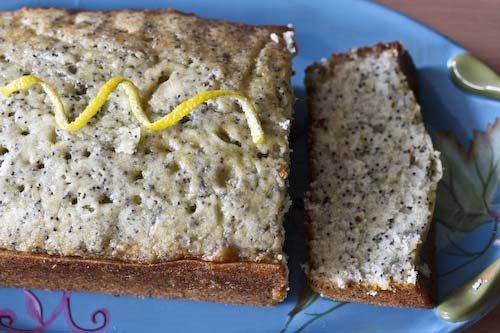
Lemon-Poppy Seed Bread


I'd like to introduce you to my new infatuation.  Some girls might always go for a rich chocolate, making sure their indulgences taste and feel indulgent.  You know, the dark and handsome type.  I for one prefer blondes.  Although I'll never turn down a piece of chocolate anything, as soon as you talk citrus you have my attention.  


When I was little, I used to tell my sister that I wanted to have a key lime wedding pie.  Or better, many key lime wedding pies, all stacked up into a tower.  I promised her a single chocolate cupcake on the side, since she insists on hating lime.  Interesting that that was the only plan I ever made for my wedding before now.  Never one to sit around and imagine my future husband, my dress, my location, the only thing I was concerned for was the food.  The more things change, the more the stay they same, as they say.


The challenge of making my own wedding cake won out over the key lime wedding pie in the end, although who knows, maybe I'll throw one together at the last second.  But to make up for it, I have this lemon cake for you.  And the reason it's so brilliant is because aside from the zest of 2 lemons in the cake itself, the lemon juice glaze moistens and brightens it, and gives it a layer of sugary stick on top so that you have to lick your fingers of all the lemony crumbs at the end.  A finger-licking cake.  Bliss.

Lemon-Poppy Seed Bread
From Beth Hensperger's The Art of Quick Breads

3 tablespoons fresh poppy seeds
1/2 cup milk (I used skim and it was fine)
5 tablespoons unsalted butter at room temperature
1 cup sugar
2 eggs
1 1/2 cups all purpose flour
1 teaspoon baking powder
Grated zest of 2 lemons
1/4 teaspoon salt

For the syrup

1/4 cup sugar
1/4 cup fresh lemon juice

Combine the poppy seeds and the milk in a bowl and let sit for 1 hour to meld flavors.

Preheat the oven to 325 F.  Cream the butter and sugar together, along with the lemon zest.  Add the eggs one at a time, being sure to beat after each addition.  In a small bowl, combine the flour, the baking powder and the salt in a small bowl.  Add these dry ingredients to the creamed ingredients in three portions.  Alternate these addition with the poppy seed milk.  Beat the mixture only until smooth.

Pour the batter into a greased 9x5" loaf pan and bake for 55-65 minutes.  In the meantime, make the lemon syrup by combining both ingredients in a small sauce pan.  Place over low heat and stir just until the sugar is dissolved in the lemon juice.  

Once the loaf is removed from the oven, pierce it all over the top with a toothpick.  Drizzle the glaze over the cake.  Allow to rest for 30 minutes in the pan before turning it out onto a rack to cool.

Notes

* The book asks that you add the zest to the dry ingredients, but I've always creamed it with the sugar.  The sugar acts as a kind of sandpaper, releasing the zest's oils into the batter.

Two Truly Great Sandwiches


I am not one of those people who rolls their eyes at a good sandwich recipe.  And no, I do not need instructions for how to make a sandwich.  But I love suggestion, innovative or perhaps just less obvious flavor combinations, another person's take on a dish everyone has mastered seemingly from birth.  Plus, and this is important, I'm marrying a Norwegian (in less than a week, I might add).  Let me explain, from the beginning.


I come from a long line of food appreciators.  Perhaps not cooks all of them, but definitely a group of people who love to eat, love to try new things, just love food.  Especially my dad's side of the family.  One of the first times my father met R, they used a nearby street fair as an excuse to escape the shopping my sister, mother and I were doing.  And my dad's first question once he had R alone?  "So what do you eat in Norway.  What would you call your national food."  R looked right at him, and replied simply, matter-of-factly, "Sandwiches".  Not lefse, not lutefisk (although honestly if I were Norwegian I'm not sure I'd admit to that stuff either), not brunost.  Sandwiches.  


Of course, he was thinking about what he ate on a daily basis in Norway, and what he meant were those open-face sandwiches, often on cracker breads like Wasa, topped with cold cuts, cheese, fish sometimes, vegetables, cream cheese, tiny little shrimps, the list goes on.  And it's true, that really is part of the bread and butter (if you'll allow me the indulgence) of day to day eating.  In the mornings, Wasa topped with a slice of ham, some cheese, sliced tomato and cucumber.  A surprisingly delicious breakfast, actually, filling and healthy.  Or brunost, also sitting atop that same Wasa, complimented by a smearing of strawberry jam (oh yum).  

We North Americans aren't bad at the sandwich either, by the way.  And the two following recipes, from Angela Tunner's Simply Summer, prove that a little inspiration and creativity can lead to bliss between two slices of bread.  The balsamic onion recipe makes more than you'll use, but it's nice to have around.  in fact, I used the leftovers to prepare the chicken and brie sandwich for a picnic in the park with my very-soon-to-be in-laws.  And even the Norwegians were impressed. 

Chicken and Brie Sandwiches with Balsamic Onions

For 2 sandwiches

4 slices thick country bread
2 teaspoons mayonnaise
2 teaspoons apricot jam
Sliced cooked chicken breast
Brie cheese (camembert would also work well)
One ripe pear, unpeeled but thinly sliced
4 leaves butter lettuce
Balsamic onions (recipe follows, you probably won't use all of it)

Make a sandwich.


Balsamic Onions

1 large onion, chopped into 1/4" chunks
1/2 tabelspoon butter
1 tablespoon balsamic vinegar
1/2 teaspoon sugar
Pinch salt

Set a large skillet over medium high heat and add the butter.  Allow the butter to melt and bubble, then add the onions and stir to coat them with butter.  Sweat the onions for about 5 minutes until they turn glossy.  

Add the rest of the ingredients and stir to coat.  Reduce the heat to low and cook the onions for an additional 15-20 minutes, until softened, stirring occasionally.  

Fancy Tuna Melt with Fine Herbs Mayonnaise and Swiss Cheese
Makes 2 sandwiches

2 slices good bread
1 can tuna
1/4 teaspoon fresh lemon juice
2 tablespoons mayonnaise
1 teaspoon dried tarragon (I used about a tablespoon chopped fresh)
1 teaspoon fresh chives
1/4 teaspoon sea salt
Pepper, to taste
2 slices swiss cheese

Preheat your oven or toaster oven to 350 F.  Drain the tuna, but leave it slightly wet.  Put it into a mixing bowl and mix it together with the lemon juice, the mayonnaise, tarragon, chives, sea salt and pepper.  

Spoon the tuna onto each of the 2 bread slices and top with the cheese.  Heat in the oven until heated through and the cheese is melting.  I also gave it a few minutes under the broiler to brown the cheese.  Enjoy!